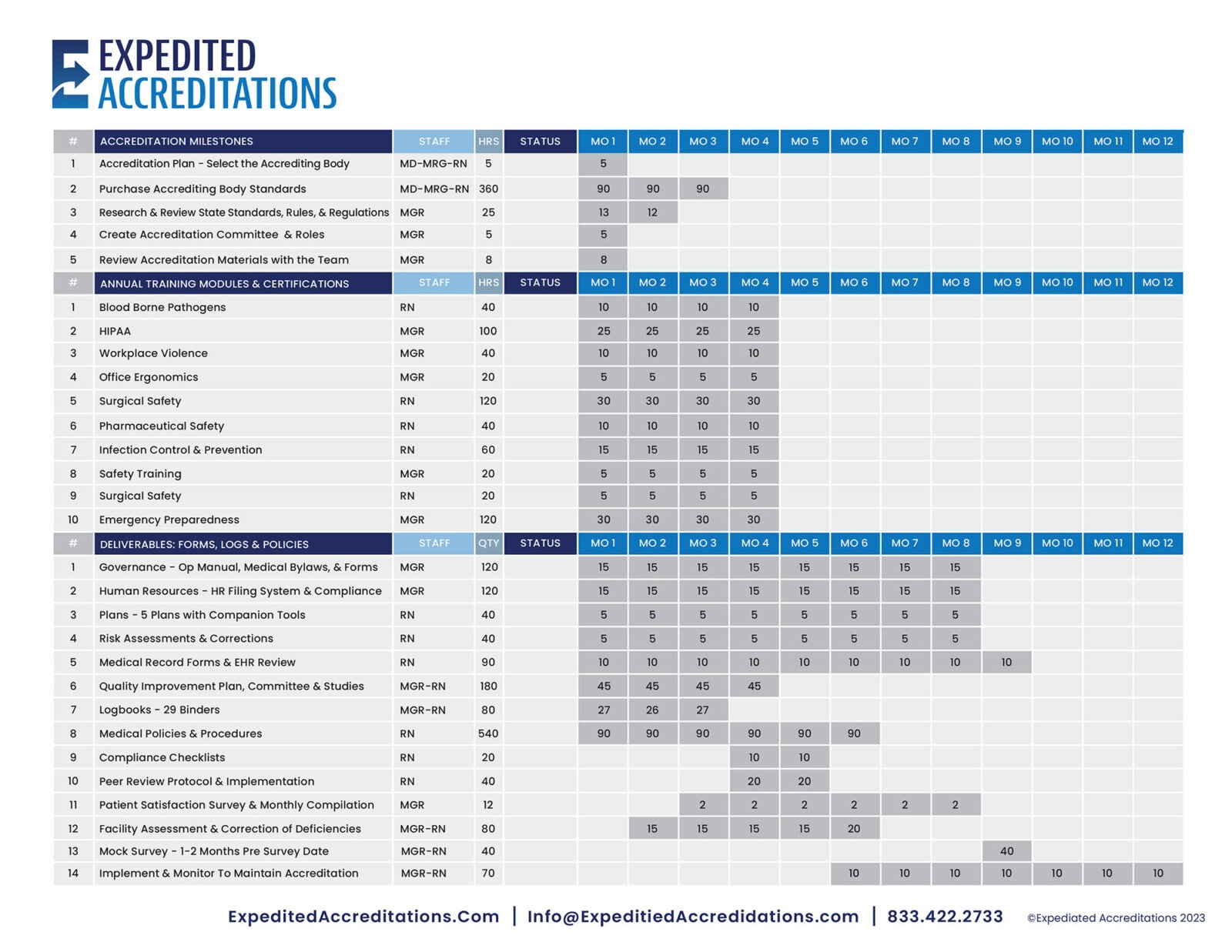
A practical guide to building survey-ready records that reflect current standards and daily practice.
Accreditation readiness is about more than having policies on a shelf. Surveyors typically look for objective evidence that your organization follows those policies consistently: records, logs, meeting minutes, competency files, patient charts, monitoring results, and documented follow-up. When the evidence is complete, current, and easy to retrieve, the survey can move more efficiently and staff can answer questions with greater confidence.
There is no single checklist that fits every organization. The required record set depends on your accrediting organization, program, scope of services, location, and applicable federal and state requirements. Start with the current standards and program-specific survey instructions from ACHC, AAAHC, QUAD A, The Joint Commission, or the accreditor that applies to your organization.
A useful survey-readiness rule: If a requirement is not documented, current, and retrievable, a surveyor may be unable to verify that the process occurred as intended.
Start with a program-specific standards crosswalk
Before collecting files, translate the standards into a working index. A crosswalk connects each requirement to the policy, record, log, report, or other evidence that demonstrates compliance. It also helps your team identify gaps before the survey.
- Current policy and procedure manual. Confirm that every policy has the required owner, approval, effective date, review date, and revision history.
- Standards crosswalk or document index. Map each applicable standard to the exact location of supporting evidence, whether electronic or hard copy.
- Document-control master list. Identify the current approved version, remove obsolete copies from use, and retain superseded versions according to your retention policy.
- Program-specific survey list. Use the accreditor’s current pre-survey instructions, application checklist, or items-needed list as the controlling reference.
Governance, licensing, and organizational records
Surveyors may ask for evidence that the organization is properly structured, authorized, and overseen. Keep governance and regulatory records together and confirm that names, titles, addresses, ownership information, and service locations agree across documents.
- Licenses, permits, registrations, and certificates. Include current federal, state, local, professional, laboratory, pharmacy, facility, and controlled-substance documents when applicable.
- Governing-body documentation. Maintain membership lists, meeting minutes, approvals, orientation records, delegations of authority, and evidence of oversight required by your program.
- Organizational structure. Keep the organizational chart, leadership assignments, job responsibilities, backup coverage, and emergency contact information current.
- Contracts and external relationships. Maintain signed agreements, Business Associate Agreements, certificates of insurance, and evidence that contracted services are evaluated as required.
- Prior survey and regulatory follow-up. Retain reports, plans of correction, corrective-action evidence, and effectiveness checks for previous findings.
Personnel, credentialing, and competency files
Personnel documentation should show that every employee, practitioner, and contracted individual is qualified for the work assigned and remains competent over time. Review files against a single checklist so requirements are applied consistently.
- Identity, screening, and eligibility records. Maintain applications, background checks, exclusion checks, health screenings, and other required onboarding evidence, as applicable.
- Current licenses and certifications. Track expiration dates for professional licenses, CPR or life-support credentials, specialty certifications, and other required credentials.
- Job descriptions and acknowledgments. Make sure duties, qualifications, supervision, and reporting relationships match actual practice.
- Orientation, education, and competency. Keep completed checklists, training rosters, test results, skills validations, performance evaluations, and remediation or retraining records.
- Credentialing and privileging. Where applicable, retain primary-source verification, peer references, delineated privileges, approvals, reappointment records, and monitoring results.
Patient, client, and clinical records
A well-organized policy manual cannot compensate for incomplete clinical records. Review a representative sample before the survey and confirm that the documentation tells a complete, chronological story of the care or service provided.
- Census, schedules, and record lists. Prepare the active and discharged patient or client lists, appointment or procedure schedules, and other selection tools requested by the accreditor.
- Admission and rights information. Include required consents, notices, patient rights and responsibilities, privacy information, advance-directive information, and grievance instructions.
- Assessment through discharge. Verify required assessments, orders, plans of care, medication documentation, progress notes, procedure records, transfer information, discharge instructions, and follow-up.
- Timeliness and authentication. Check dates, times, signatures, credentials, co-signatures, and late-entry or correction practices against policy. Never backdate or recreate records as if they were completed earlier.
- Privacy and record access. Confirm that records are secure, available to authorized staff, retrievable during an outage, and retained for the required period.
Quality improvement, incidents, complaints, and corrective action
Quality Assessment and Performance Improvement (QAPI), Performance Improvement (PI), or Quality Improvement (QI) records should demonstrate a closed loop: the organization identifies a risk or opportunity, analyzes it, takes action, and confirms whether the action worked.
- Quality plan and assigned responsibility. Document the program, responsible leader, reporting path, selected measures, data sources, review frequency, and annual evaluation.
- Performance data and meeting records. Retain dashboards, audits, committee or governing-body minutes, trend reports, and evidence that leaders reviewed the results.
- Improvement projects. Show the baseline, goal, interventions, accountable owner, due dates, remeasurement, outcome, and next step.
- Incident, complaint, and grievance files. Maintain logs, investigations, required notifications, response letters, corrective actions, and trend analysis while protecting confidentiality.
- Corrective and preventive action. Connect each finding to a root-cause review, action plan, implementation evidence, and effectiveness check.
Infection prevention, medication, equipment, and environmental safety
These records show that safety controls are active, not simply described in policy. The exact evidence will vary considerably by service line, so use your standards and risk assessment to define the required logs.
- Infection-prevention program. Maintain the risk assessment, plan, surveillance data, exposure-control materials, hand-hygiene or cleaning audits, education, and documented response to trends.
- Cleaning, disinfection, and sterilization. Retain schedules, logs, product information, biological or chemical monitoring, and equipment records when applicable.
- Medication and supply controls. Keep storage temperature or humidity logs, expiration checks, controlled-substance records, emergency medication checks, recall documentation, and follow-up evidence as applicable.
- Equipment and utilities. Maintain inventories, preventive maintenance, repair, inspection, testing, calibration, emergency-power, and staff-use competency records.
- Environment of care. Organize safety rounds, fire-system reports, waste documentation, Safety Data Sheets, hazard assessments, and action plans for identified risks.
Emergency preparedness and continuity records
Emergency documentation should show that the organization has planned for likely hazards, trained staff, tested the plan, and improved it after exercises or actual events.
- Emergency and disaster plan. Address program-specific hazards, communication, patient continuity, staffing, evacuation or sheltering, utilities, supplies, records, and recovery.
- Training and exercises. Keep attendance records, drill scenarios, observations, after-action reviews, improvement plans, assigned owners, and completion evidence.
- Life-safety readiness. Maintain fire and evacuation drill reports, emergency equipment checks, alarm or inspection reports, and staff response education when applicable.
Build one survey-ready document system
A surveyor should not have to wait while staff search across email, shared drives, binders, and individual desktops. Create one controlled index with clear ownership. A practical top-level structure is:
- Standards and Crosswalk – current standards, program instructions, evidence index, and document controls.
- Governance and Licensure – licenses, permits, leadership, and governing-body records.
- Personnel and Competency – employee, practitioner, contracted staff, training, and competency files.
- Patient and Clinical Records – requested lists plus representative active and discharged records.
- Quality and Risk – QAPI or PI materials, incidents, complaints, investigations, and corrective actions.
- Infection, Safety, Medication, and Equipment – program plans, monitoring, maintenance, testing, and recall logs.
- Emergency Preparedness – plans, training, drills, after-action reviews, and continuity documentation.
- Contracts and Prior Surveys – vendor oversight, agreements, regulatory reports, and sustained-correction evidence.
Give each section an owner and backup. Test access from the location and device staff will use during the survey, and keep an approved downtime method for records that may become unavailable electronically.
Common documentation gaps to correct before survey
- Policy-practice mismatch. The written process does not match what staff actually do or what records show.
- Missing approvals or authentication. Policies, minutes, assessments, logs, and corrective actions lack required dates, signatures, credentials, or evidence of approval.
- Expired or incomplete personnel records. Licenses, credentials, training, evaluations, or competencies are missing or out of date.
- Open-loop findings. An audit, incident, complaint, or drill identifies a problem, but no completed action or effectiveness review is documented.
- Inconsistent information. Names, addresses, service locations, staff rosters, dates, or scopes of service conflict across files.
- Logs without meaningful review. Data are collected but never analyzed, reported, or used to improve performance.
- Scattered or inaccessible evidence. Requested records cannot be retrieved promptly, or no backup access plan exists.
Complete a final readiness check
Before the survey, complete a focused internal review:
- Validate the checklist. Confirm it reflects the current edition, program, scope of services, and survey instructions.
- Sample files. Review a representative set of personnel, credentialing, patient, training, and quality records against your standards crosswalk.
- Run tracers. Follow selected patients, medications, equipment, incidents, complaints, or infection-control activities from policy through documentation and follow-up.
- Test retrieval. Ask staff to locate commonly requested documents and explain the process in their own words.
- Close and sustain gaps. Document corrections, assign accountability, verify completion, and recheck high-risk items before the survey.
Prepare with confidence
Expedited Accreditations helps healthcare organizations streamline accreditation preparation, identify documentation gaps, train staff, complete mock survey activities, respond to findings, and maintain readiness between surveys. Support is tailored to your organization, chosen accreditor, program, and scope of services.
Ready to organize your documentation and move forward? Schedule a complimentary consultation at expeditedaccreditations.com/contact-us, call (971) 429-6379, or email info@expeditedaccreditations.com.